What Was the First Stablecoin?
The usual answers are BitUSD or Tether, both 2014. An older candidate is a gold coin from AD 312 — and why it held for roughly seven hundred years, then failed, is a useful test for any stablecoin issued since.
The textbook answer: the first stablecoins appeared in 2014 — BitUSD on BitShares in July, then Realcoin, which became Tether. If the question is "the first blockchain token engineered to hold a fixed value," that answer is correct and uninteresting.
The better question is older: when did someone first engineer money to stay stable — and actually make it work? That answer is AD 312, and it comes stamped with an emperor's face.
The coin that held
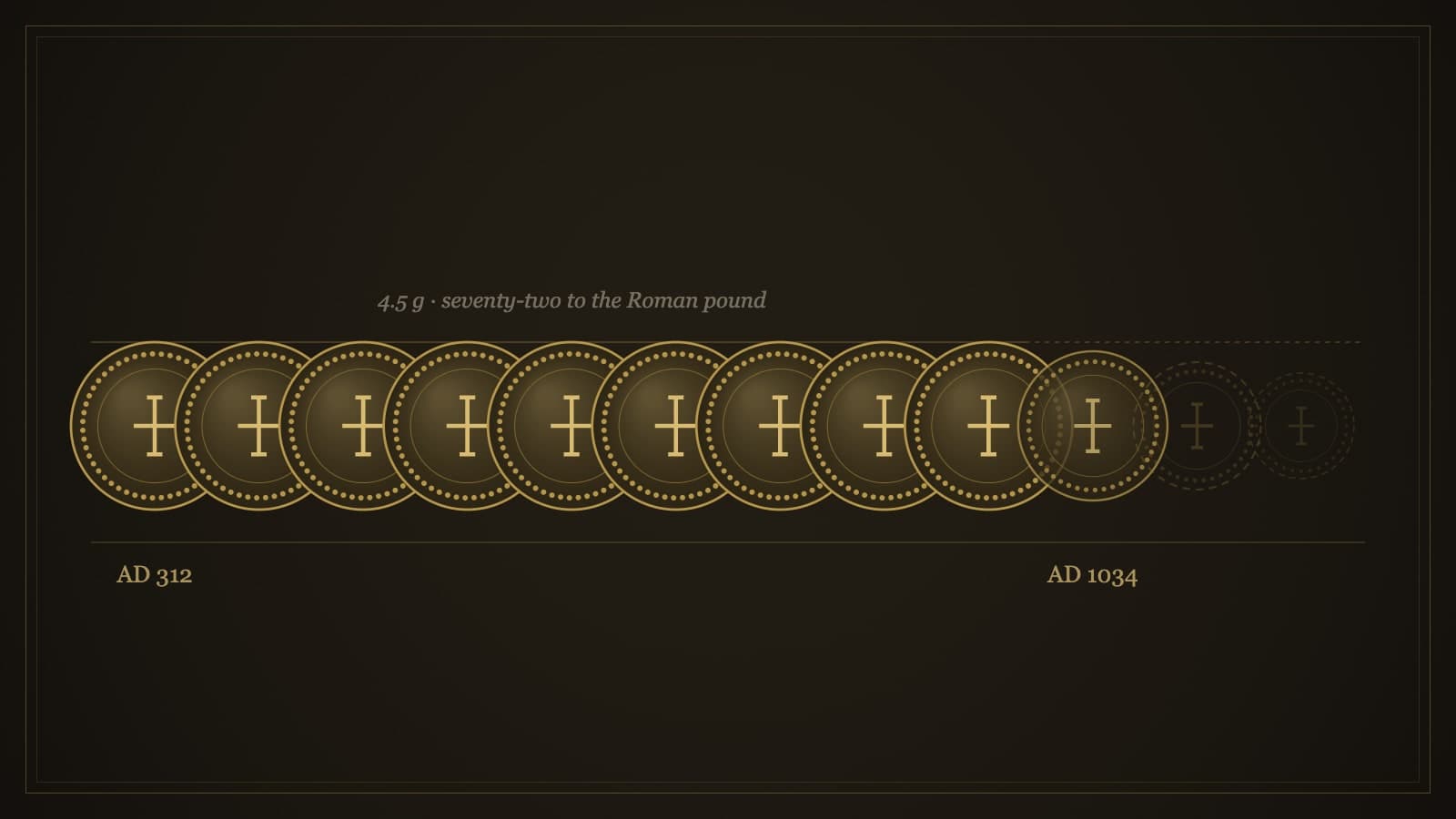
Constantine's mint began striking the solidus at seventy-two to the Roman pound. It kept that standard for roughly seven centuries. Merchants who had never seen a Roman soldier priced goods in it; hoards still turn up at both ends of the trade routes. A sixth-century trader wrote that it was accepted everywhere, from one end of the earth to the other.
Notice what it did not have: no peg, no reserve, no oracle, no attestation schedule. Its stability was a property of the object. Anyone with a scale could audit it. In modern terms the solidus was a bearer instrument with built-in proof of reserves — which is why I call it the first stablecoin by achievement, if not by ticker.
The full history of the coin is here; what matters for stablecoins is the mechanism, and the failure.
Stability is a policy, not a property
Gold did not make the solidus stable. Rome had gold coinage for centuries and debased it whenever the treasury ran short. What made the solidus different was a standing decision, renewed across some fifty emperors, not to touch the standard.
That decision is the hard part, and it is the part most monetary projects still get wrong. Any mechanism holds its peg on a calm Tuesday. The question that matters is what happens when the issuer is under pressure and quietly loosening the standard would solve this quarter's problem.
The empire eventually answered that question badly. From around 1034, emperors facing deficits began reducing the gold content — each cut small, defensible, temporary. Within about fifty years the coin fell from twenty-four carats toward eight, and a reputation compounded over seven centuries was gone in a generation. Traders noticed before historians did.
Durable money does not fail from age. It fails from discretion.
How to evaluate a stablecoin
That lesson turns into three questions worth asking of any issuer:
- Who has the power to quietly change the standard — reserve composition, redemption terms, issuance rules?
- Is the promise verified by mechanism (attestations, on-chain reserves, audits with consequences) or by reputation?
- What happens to the standard on the issuer's worst day, when breaking it quietly would solve a real problem?
The 2014 generation made stability programmable. Whether any of it becomes durable — measured against seven hundred years — depends on the same discipline Constantine's mint kept and its successors spent.
Why we measure against a coin
I have spent twenty years on the machinery of engineered trust: payments, identity verification, zero-knowledge proofs, verifiable credentials. The pattern never changes — wherever a promise can be replaced by a proof, replace it. The solidus never asked to be believed. It could be weighed.
That is the thesis Byzantine Solidus is built on, and it is why our first holding, Permara, is infrastructure rather than a token: the operating layer where programmable money has to keep its promises every day, to people, businesses, and AI agents alike.
So: what was the first stablecoin? BitUSD, if you mean the ticker. The solidus, if you mean the achievement. We named the company after the achievement.